
Where to go next
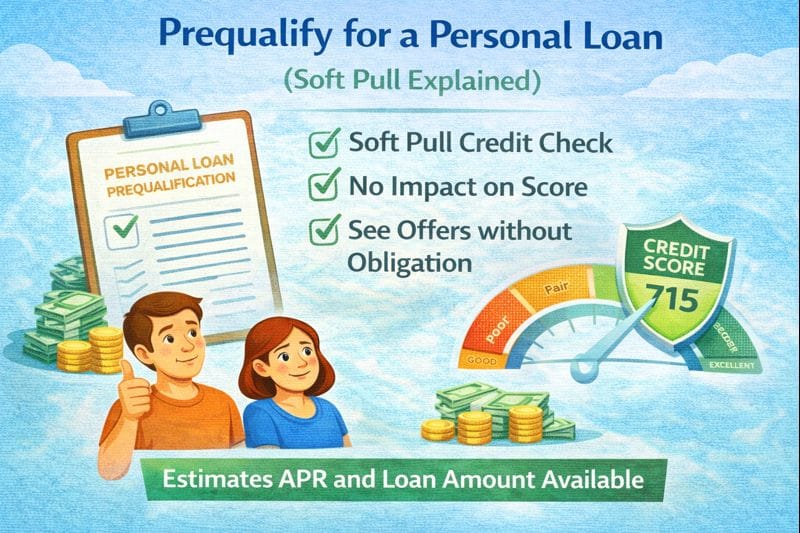
Prequalifying is how you shop personal loan offers without firing blind hard inquiries everywhere. If you do it right, you can see likely APR/payment ranges first, then apply only where the deal actually makes sense.
This guide explains what it means to prequalify for a personal loan, how soft pull prequalification works, whether prequalifying hurts your credit, and how pre-approval differs from prequalify.
Quick answer / Key takeaways
- Prequalification often uses a soft pull to estimate offers and typically does not hurt your score.
- A full application usually triggers a hard inquiry (that’s the one that can move your score).
- Prequalify first, then apply only to the best offers to limit hard pulls.
- Pre-approval and prequalification are not always the same—terms vary by lender.
- Still compare offers by total cost, not just APR or payment: how to compare loan offers.
What does it mean to prequalify for a personal loan?
Prequalification is an initial screening that estimates what you might qualify for based on:
- basic identity and income info you provide, and
- a credit check that is often a soft pull.
It’s designed to reduce guesswork. It’s not always a guarantee.
If you’re new to how personal loans work:
how personal loans work.
Prequalification soft pull (how it works)
This answers your tail: “prequalification soft pull.”
Soft pull = “look but don’t commit”
A soft pull is a credit check that generally doesn’t affect your score the way a hard inquiry can.
What you typically get from prequal
- estimated APR range
- estimated monthly payment range
- possible loan amounts and terms
- sometimes the likelihood of approval
What can change after prequal
Final terms can change after:
- full identity verification
- income verification
- final underwriting
- the lender runs a hard inquiry and confirms your full file
Requirements and docs that can affect final approval:
personal loan requirements documents.
Does prequalifying hurt your credit?
This answers your tail: “does prequalifying hurt credit.”
Usually, prequalifying does not hurt your credit if it’s a soft pull. But you should still read the lender’s wording before you submit.
Rule you can follow:
If it says “soft credit check” or “no impact to your score,” that’s the safer prequal path.
If it says “this will not affect your credit score” but later asks for a full application, the hard inquiry comes later.
Hard inquiry breakdown: hard inquiry impact.
Pre-approval vs prequalify (what’s the difference?)
This answers your tail: “pre-approval vs prequalify.”
These terms are used inconsistently. Here’s the practical difference.
Prequalification (often lighter)
- usually a soft pull
- gives estimated offers
- less documentation up front
- not always a firm commitment
Pre-approval (often stronger, but not always)
- may involve more verification
- may be closer to a final offer
- may still require a hard inquiry or final underwriting step
Practical takeaway: treat both as “not final” until you see the final offer and loan agreement.
How to prequalify the smart way (step-by-step)
Step 1: Get your numbers straight
Know:
- how much you need,
- your target payment,
- your purpose (consolidation, big expense, etc.).
If you’re consolidating, start here:
debt consolidation loans.
Step 2: Prequalify with multiple lenders (but keep it organized)
Keep a simple list of offers with:
- APR range
- fees (especially origination fees)
- term length options
- estimated payment
- any special conditions
Fees guide: personal loan fees.
Origination fee deep dive: origination fee explained.
Step 3: Shortlist the best offers
Cut it down to the top 1–3 based on total cost and payment comfort.
Step 4: Apply only where it makes sense
This is how you limit hard inquiries.
hard inquiry impact.
Step 5: Verify final terms before accepting
Final checklist:
- APR and interest rate
- origination fee and net funding amount
- late fee rules
- prepayment penalty rules
- total amount repaid
Offer comparison checklist: how to compare loan offers.
Table: Prequalify vs apply (what changes)
| Stage | Credit check type | What you get | Risk |
|---|---|---|---|
| Prequalify | Often soft pull | Estimated offers | Not final; terms can change |
| Full application | Often hard inquiry | Final decision + terms | Can affect score; denial possible |
| Funding/closing | Verification + contract | Money disbursed | Fees/terms locked in |
Common mistakes
- Prequalifying and treating the offer as guaranteed.
- Applying everywhere instead of shortlisting (stacking hard inquiries).
- Comparing only monthly payment and ignoring fees/total cost.
How to compare loan offers. - Ignoring DTI and getting denied even with decent credit.
Dti for personal loans.
Examples / scenarios
Scenario 1: “I want the best rate without hurting my score.”
Prequalify with several lenders, shortlist, then apply only to the best one or two.
Hard inquiry impact.
Scenario 2: “I got prequalified but denied later.”
Usually verification didn’t match: income, DTI, or identity. Prep documents and re-apply strategically.
Personal loan requirements documents.
Scenario 3: “I’m consolidating and need a specific payoff amount.”
Prequal offers aren’t enough—confirm origination fee and net funding in final terms.
Origination fee explained.
FAQ
What does it mean to prequalify for a personal loan?
It’s an initial screening that estimates likely loan offers, often using a soft credit pull.
Does prequalifying hurt your credit?
Usually no if it’s a soft pull. A hard inquiry typically happens at the full application stage.
Is pre-approval the same as prequalification?
Not always. Pre-approval may involve more verification and may be closer to final terms, but it still might not be final.
Should I prequalify with multiple lenders?
Yes, if it’s soft pull and you stay organized—then apply only to the best offers.
What should I compare after prequalifying?
APR, fees (especially origination), term length, monthly payment, and total cost.
How to compare loan offers.