
Where to go next
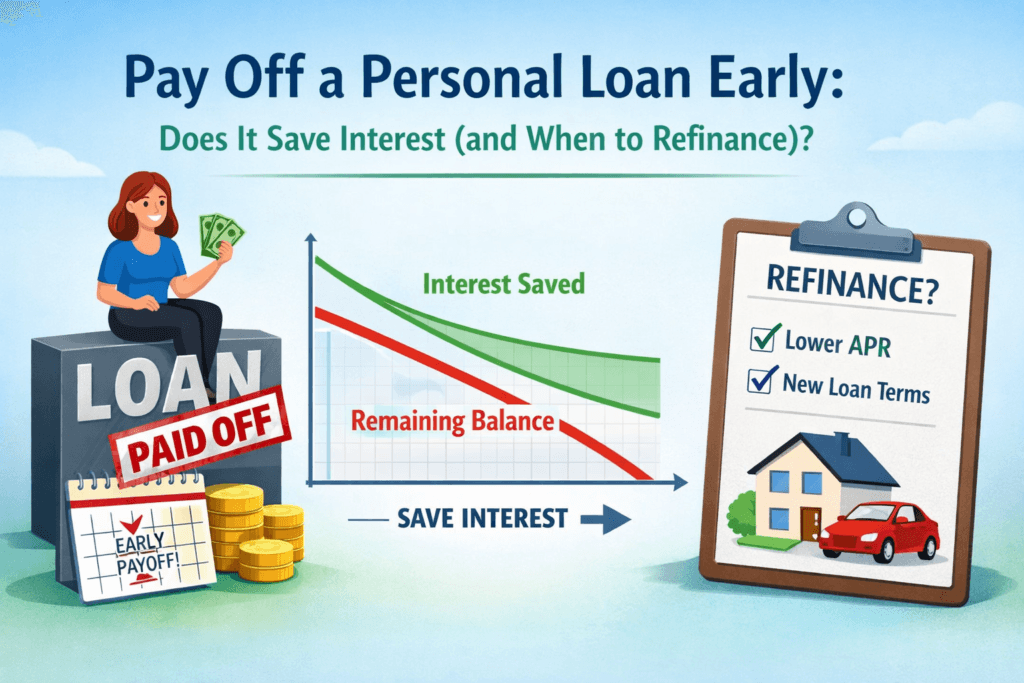
Paying off a personal loan early can save you real money—because interest is tied to how long you carry the balance. But there are two catches people miss:
- some loans have prepayment penalties (less common, but it happens), and
- “extra payments” only help if they’re applied correctly (principal vs next due date games).
This guide explains how early payoff works, when it saves the most interest, how to avoid prepayment penalty surprises, and when refinancing to a lower APR actually makes sense.
Quick answer / Key takeaways
- Yes, early payoff usually saves interest—because you reduce the time your balance accrues interest.
- First move: check for prepayment penalties and how extra payments are applied.
- The biggest savings usually come early in the loan (first 6–18 months).
- Make sure extra payments go to principal, not just “next month due.”
- Refinancing can make sense if you can drop APR enough and the fees don’t erase the savings.
Does early payoff save interest?
This answers your tail: “does early payoff save interest.”
In most personal loans, interest is calculated based on:
- your current principal balance, and
- how long the balance stays outstanding.
When you pay extra toward principal, you reduce the balance earlier, which reduces future interest.
Why early payoff saves more early in the loan
Early in the loan, your balance is highest. That’s when extra principal payments usually create the biggest interest savings.
Prepayment penalty: what it is and how to spot it
This answers your tail: “prepayment penalty.”
A prepayment penalty is a fee charged if you pay the loan off early (or pay above a certain amount). It’s not universal, but you must check because it can turn “smart payoff” into “meh payoff.”
Where to check
- loan agreement (look for “prepayment,” “early payoff,” “penalty,” “finance charge”)
- lender FAQ or account terms
- payoff quote screen (some lenders show fee line items)
Fees overview: personal loan fees
Practical rule: don’t assume “no penalty.” Confirm it.
Extra payments: how to do it the right way (so it actually helps)
Two payments can be the same dollar amount and produce different results depending on how they’re applied.
What you want
- extra payment applied to principal
- loan term shortened or interest reduced (depending on lender structure)
What you don’t want
- extra payment treated as “prepaying next month,” leaving the principal reduction smaller than you expected
If your lender offers options like:
- “apply to principal”
- “advance due date”
choose the option that reduces principal (unless your strategy is different).
Table: Early payoff vs refinancing (which tool fits?)
| Goal | Early payoff (same loan) | Refinance (new loan) |
|---|---|---|
| Lower total interest | Yes, if no penalty and you pay extra | Yes, if APR drop is meaningful and fees don’t erase it |
| Lower monthly payment | Not necessarily | Often yes (depends on term) |
| Pay off faster | Yes | Yes (if you choose shorter term) |
| Complexity | Low | Medium (new application + underwriting) |
| Risk | Low | Medium (new inquiry + fees + term reset risk) |
| Best for | You can afford extra payments now | You can qualify for a lower APR or better terms |
APR basics if you’re comparing offers: personal loan apr explained
How to compare offers: how to compare loan offers
Step-by-step: pay off a personal loan early (clean process)
Step 1: Get the payoff quote
A payoff quote tells you exactly what ends the loan on a specific date (interest accrues daily in many cases). The payoff amount can change depending on the date.
Step 2: Check prepayment terms and fees
Confirm:
- any prepayment penalty
- whether interest is precomputed (less common)
- whether there are special payoff instructions
Step 3: Choose your strategy
Pick one:
- extra principal each month (steady win), or
- one or two big principal hits (windfall strategy), or
- biweekly payments (helps some borrowers stay consistent)
Step 4: Set payments to apply to principal
If your lender has a toggle/setting, use it. If not, contact support and confirm how it’s applied.
Step 5: Keep receipts and confirm the loan is closed
After the final payoff:
- confirm the account shows paid in full
- save confirmation documents
- track that autopay is turned off
When refinancing makes sense (and when it doesn’t)
This answers your tail: “refinance personal loan to lower APR.”
Refinance can make sense if…
- your credit score improved since you borrowed,
- you can reduce APR enough to create real savings,
- fees are low (or none),
- the new loan doesn’t reset you into a longer timeline that increases total cost.
Credit score considerations: credit score needed
Hard inquiry impact: hard inquiry impact
Refinance is often a bad idea if…
- you extend the term just to lower payment and end up paying more interest overall,
- origination fees wipe out savings,
- you’re refinancing repeatedly (inquiry + fee churn).
Origination fee details: origination fee explained
Term tradeoffs: loan term length
Refinance checklist (before you apply)
- Prequalify if possible (reduce unnecessary hard inquiries)
- Compare by total cost, not payment
- Watch the “term reset” trap
If you’ve already paid for 12–18 months and you refinance into a brand-new long term, you might lower payment but increase total cost. - Confirm fees and net funding
personal loan fees
origination fee explained
Common mistakes
- Paying extra but selecting “advance due date,” then wondering why savings are small.
- Ignoring payoff quotes and sending the wrong final amount.
- Refinancing into a longer term and paying more in total.
- Assuming refinancing is “free money” without checking fees.
- Forgetting prepayment penalties.
Examples / scenarios (If X → do Y)
Scenario 1: “I just got a bonus—should I pay the loan down?”
If there’s no penalty, a principal payment can reduce interest and shorten payoff. Make sure it applies to principal and get a payoff quote if you’re closing it out.
Scenario 2: “My credit improved since I took the loan.”
Prequalify and compare refinance offers. If APR drops meaningfully and fees are low, refinancing can reduce total cost.
Prequalify soft pull
How to compare loan offers
Scenario 3: “I want a lower payment, but I don’t want to overpay.”
Watch the term length. A lower payment isn’t a win if total interest explodes.
Loan term length
FAQ
Does paying off a personal loan early save interest?
Usually yes, because you reduce the balance sooner and shorten the time interest accrues.
How do I pay off a personal loan early?
Get a payoff quote, confirm any fees, make sure extra payments apply to principal, and keep payoff confirmation records.
Is there a penalty for paying off a personal loan early?
Sometimes. Check your loan agreement and fee schedule.
Personal loan fees
Should I refinance my personal loan to a lower APR?
It can make sense if the APR drop is meaningful and fees don’t erase the savings. Compare total cost and watch term length.
How to compare loan offers
Loan term length
Will refinancing hurt my credit?
A new application can trigger a hard inquiry and temporarily affect your score.
Hard inquiry impact
Is it better to refinance or just pay extra?
If you can afford extra payments and there’s no penalty, early payoff is simple. Refinance is worth it when the APR drop is large enough to justify the process and fees.