
Where to go next
- Debt Relief hub
- Debt settlement: how it works
- Debt management plan (DMP)
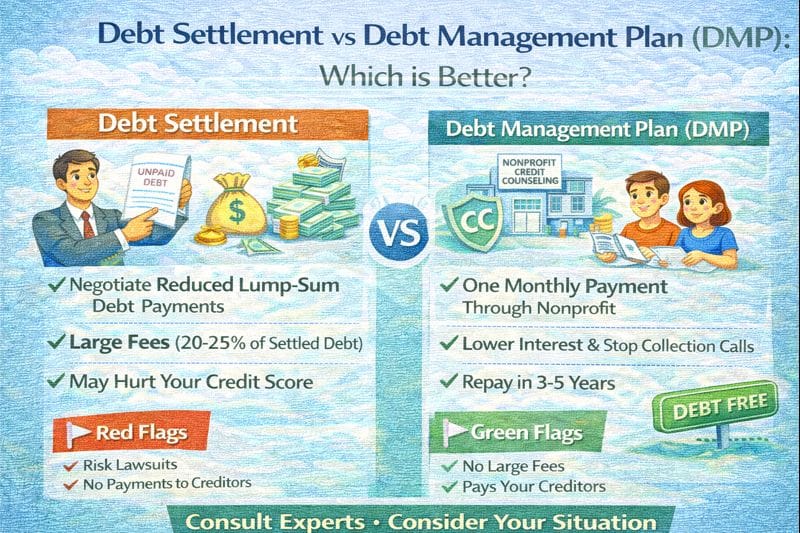
Debt settlement and a debt management plan (DMP) are not “two versions of the same thing.” They’re two different strategies with different risks.
- A DMP is structured repayment designed to make full repayment realistic by lowering interest and organizing payments.
- Debt settlement aims to resolve debts for less than you owe, often after accounts become delinquent—trading potential savings for higher credit damage and higher collection risk.
This page helps you choose quickly based on your payment status, your monthly budget, and your risk tolerance.
Quick answer / Key takeaways
- Pick a DMP if you can repay 100% of principal once interest and fees are reduced (often a 3–5 year plan).
- Pick settlement only if full repayment is not realistic even with lower interest—expect more credit impact and more uncertainty.
- Credit impact: settlement is usually worse because it often involves late payments/charge-offs/collections. A DMP can still affect credit (accounts may be closed), but it’s typically more stable if you pay on time.
- Risk: settlement generally carries higher collections and lawsuit risk, especially if you stop paying creditors.
- If you’re considering stopping payments as part of settlement, read this first: stop paying credit cards what happens.
What each option actually does
Debt Management Plan (DMP)
A DMP is a repayment plan (often set up through credit counseling) that aims to:
- reduce interest rates and some fees (when creditors agree),
- roll multiple debts into one structured monthly payment,
- pay off balances in a predictable time frame (commonly 3–5 years).
Full breakdown: debt management plan dmp.
How to choose an agency: credit counseling how to choose.
Debt settlement
Debt settlement aims to resolve debts for less than the full balance by negotiating with creditors/collectors. In many real-world cases, settlement negotiations happen after accounts are delinquent, which can:
- increase credit damage,
- increase collections pressure,
- increase the chance of a lawsuit.
Mechanics and timeline: debt settlement how it works.
DMP vs settlement (side-by-side table)
| Category | Debt Management Plan (DMP) | Debt settlement |
|---|---|---|
| Goal | Repay full principal with reduced interest/fees | Resolve for less than owed (principal reduction) |
| Best for | You can repay if terms improve | You cannot repay 100% even with lower interest |
| Typical payment status | Works best if current or slightly behind | Often pursued after delinquency |
| Timeline | Usually 3–5 years | Often 24+ months (varies widely) |
| Monthly payment | Predictable structured payment | Often “save-first, settle later” (less predictable) |
| Fees | Setup + monthly admin fee (varies) | Fees if using a company + possible extra costs |
| Credit impact (typical) | Moderate; accounts may be closed but payments can stay consistent | Often heavier due to late payments/charge-offs/collections |
| Collections / lawsuit risk | Lower if you stay current | Higher, especially if you stop paying |
| Tax consequences | Usually none from forgiveness | Possible tax impact on forgiven debt: /debt-relief/debt-settlement-taxes-1099c/ |
| Predictability | High | Medium/low |
Debt management plan vs settlement: which is better?
Use this decision logic—no guessing.
A DMP is usually better if…
- you’re still mostly current (or only slightly behind),
- you can afford repayment if interest drops,
- you want a lower-risk, more predictable path,
- you want to avoid aggressive collections as much as possible.
Settlement is usually better only if…
- you cannot repay 100% within a realistic timeframe even with lower APR,
- your budget cannot support minimum payments and won’t improve soon,
- you accept that delinquency/collections may happen,
- you can consistently build funds to offer settlements.
If you’re already getting aggressive collection pressure or you’re worried about escalation, read:
credit card lawsuit garnishment.
DMP vs settlement credit impact (what to expect)
People ask “which is better for credit” because they’re thinking about renting, refinancing, car loans, and approvals.
DMP: common credit pattern
- You typically make consistent payments under a plan.
- Some creditors may close or restrict accounts (which can affect utilization).
- Over time, balances decline in a structured way.
Settlement: common credit pattern
- Settlement often involves delinquency, which is a major negative factor in credit reporting.
- Accounts may charge off or go to collections before resolution.
- Even when resolved, the path there can leave stronger negative marks.
Practical takeaway: if protecting credit is a priority and you can repay with improved terms, a DMP is usually the safer play.
Costs and risks that decide the outcome
DMP costs/risks (plain English)
- Usually includes a setup fee and a monthly admin fee (varies).
- Some accounts may be closed or restricted.
- The main advantage is predictability and lower escalation risk if you stay current.
Settlement costs/risks (plain English)
- Fees if you use a settlement company.
- Higher chance of collections pressure and legal escalation if accounts go delinquent.
- Possible tax impact on forgiven debt: debt settlement taxes 1099c.
- Scam risk is higher here—know the red flags: debt relief scams red flags.
How to choose fast (3-step checklist)
Step 1: Find your real monthly debt capacity
After essentials (housing, utilities, food, transportation, insurance), what is left for debt each month?
Step 2: Compare capacity vs minimum payments
- If you can cover minimums and repayment becomes realistic with lower interest → lean DMP.
- If you cannot cover minimums and won’t be able to for a long stretch → settlement may be on the table.
Step 3: Decide on risk tolerance
Ask yourself: “Can I handle months of uncertainty and possible escalation if accounts become delinquent?”
If not, DMP (or another lower-risk option) usually comes first.
What to do next (based on your choice)
If you’re leaning toward a DMP
- List each debt: balance, APR, minimum payment, and whether you’re current.
- Build a simple budget and identify your debt payment capacity.
- Talk to a counseling agency and ask for specifics: payment amount, timeline, fees, and what happens if you miss a payment.
- Use a selection checklist: credit counseling how to choose.
If you’re leaning toward settlement
- Understand the full workflow and timeline: debt settlement how it works.
- Read the consequences of stopping payments first: stop paying credit cards what happens.
- Confirm you can consistently build a settlement fund.
- Factor in tax questions if debt is forgiven: debt settlement taxes 1099c.
- Do a scam/red-flag check before signing anything: debt relief scams red flags.
Real-world scenarios (If X → do Y)
Scenario 1: You’re current, but interest is crushing you
If you’re paying on time but barely making progress because of APR, start with a DMP path:
debt management plan dmp.
Scenario 2: You’re behind and minimum payments are not realistic
If you’re delinquent and cannot repay in full, settlement may fit—but only after you understand consequences and risk:
stop paying credit cards what happens.
debt settlement how it works.
Scenario 3: You still qualify for a lower-interest product
If your credit/income can qualify you for a lower APR and you can avoid re-borrowing, compare consolidation vs relief:
debt relief vs debt consolidation.
FAQ
Debt settlement vs debt management plan: which is better?
A DMP is usually better if you can repay in full with reduced interest and want a predictable plan. Settlement may fit if full repayment is not realistic and you accept higher risk and credit impact.
Is a DMP the same as debt settlement?
No. A DMP is structured repayment (often full principal). Settlement aims to reduce what you pay back through negotiation.
Does a DMP hurt your credit?
It can affect credit indirectly (accounts may be closed), but it’s typically less damaging than delinquency-based settlement.
Is settlement always cheaper?
Not necessarily. Outcomes depend on how much is reduced, how long it takes, fees, and possible tax impact.
What happens if I stop paying as part of settlement?
Late fees, charge-offs, collections, and possible lawsuits can happen. Timeline overview: stop paying credit cards what happens.
Can a creditor sue me during settlement?
Yes, it can happen. If this is a concern, read: credit card lawsuit garnishment.
Related guides
- Debt relief options (explained)
- Hardship programs (with creditors)