
Where to go next
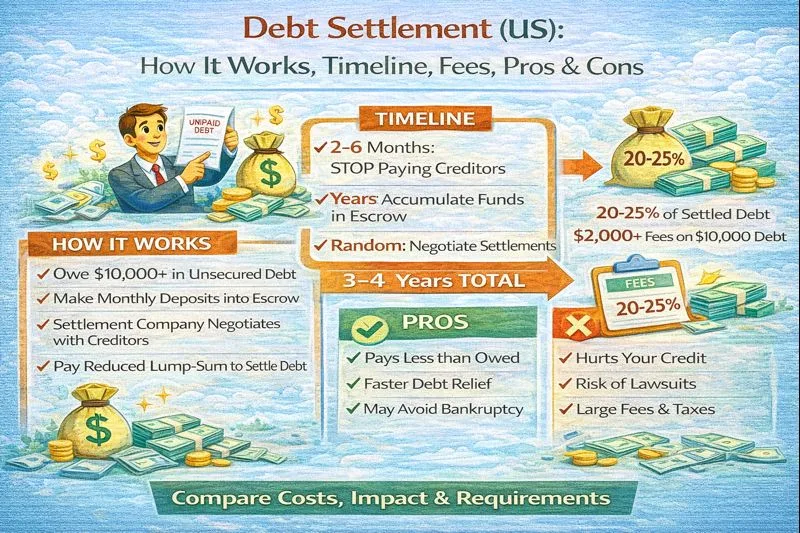
Debt settlement is a debt relief strategy where you negotiate with creditors or collectors to resolve unsecured debt (usually credit cards and some collections) for less than the full balance. It can reduce what you owe—but it comes with tradeoffs: credit impact, collection activity, lawsuit risk, and the need for a realistic funding plan.
This guide explains how debt settlement works, the typical timeline, fee structures, and what to watch for so you don’t get sold a fantasy.
Quick answer / Key takeaways
- Debt settlement is usually used when full repayment isn’t realistic—it’s not a “discount program” for people who can pay.
- Most real settlements are negotiated after delinquency, which usually means more credit damage and more collections pressure.
- Timeline is typically months, not days—often accounts resolve one-by-one as you fund offers.
- Fees vary widely; compare total dollars paid (settlements + all fees), not “percent savings.”
- Lawsuits can happen during the process: credit card lawsuit garnishment.
- If you can afford structured repayment, a DMP is often lower risk: debt management plan dmp.
Start here: is debt settlement a fit?
Debt settlement may fit if:
- you’re behind (or about to be) and can’t pay minimums consistently,
- you can set aside money monthly to fund offers,
- you understand the risks (credit damage, collections, possible lawsuits, possible taxes).
Debt settlement is usually a bad fit if:
- you can afford a stable monthly payment with reduced interest,
- you want to avoid delinquency and escalation,
- you don’t have cash flow to build a settlement fund.
If you can afford structured monthly repayment, start here instead:
- Debt management plan (DMP)
- Credit counseling: how to choose
If the issue is temporary, try hardship first: creditor hardship programs.
Debt Settlement Fund Calculator
Rough estimate: how long it takes to build a settlement fund based on your monthly deposit.
Educational estimate only. Real settlements vary by creditor, delinquency stage, and timing. Lawsuit risk and taxes (1099-C) may apply.
What to do next (based on your timeline)
- If funding takes 6–24 months: settlement may be realistic — read the steps below, then compare it with a DMP.
- If it takes 2–5 years: pause and sanity-check the plan — hardship or a DMP is often safer.
- If it’s 5+ years: settlement is usually a bad fit — start with hardship, DMP, or consolidation options.
How debt settlement works (step-by-step)
- Accounts become delinquent (or are already in collections)
Many negotiations happen once an account is behind. That’s part of why settlement can hit credit harder. - You (or a company) negotiates with the creditor/collector
You’re trying to agree on a lump sum (or short payment plan) to resolve the balance. - You get the agreement in writing
Non-negotiable: written terms that confirm:
- settlement amount,
- due date(s),
- what happens after payment (account resolved/settled language).
- You pay the settlement
Once paid, the account is resolved per the agreement. - Credit reporting updates over time
Timing varies. Your report reflects the delinquency history that happened on the way there.
Debt settlement sits inside a broader options map:
Debt relief options (explained)
Ask for hardship first (fast script + email template)
If your issue is temporary, a hardship plan can reduce APR/payments without going delinquent.
Phone script (60 seconds)
- “Hi, I’m calling about my account. I’m having a temporary hardship and want to avoid falling behind.”
- “Can you offer a hardship program — lower APR, reduced payment, or a short-term forbearance?”
- “If approved, can you confirm: new APR, new payment, duration, and whether fees/penalties are waived?”
- “Please note my account: I’m requesting hardship options to stay current.”
Email template (copy/paste)
Subject: Hardship request — payment assistance
Hello,
I’m experiencing a temporary financial hardship and I want to keep my account in good standing. Please let me know what hardship options are available (reduced APR, reduced payment, or a short-term payment plan).
If approved, please confirm the new APR, monthly payment, start date, duration, and whether fees are waived.
Thank you,
[Full name]
[Account last 4 digits]
More details: creditor hardship programs
Debt settlement timeline (how long it takes)
Settlement is rarely instant. Timeline depends on:
- creditor/collector behavior,
- how delinquent the account is,
- how quickly you can fund offers,
- number of accounts and total debt.
Typical timeline (simple)
- Weeks 1–4: list debts, stop new borrowing, set a monthly “settlement fund.”
- Months 2–6: negotiations may begin (varies); expect back-and-forth.
- Months 6–18+: accounts resolve one-by-one depending on funding speed and responses.
- After resolution: rebuilding is about new positives (on-time payments, lower utilization, clean habits).
If you’re considering stopping payments, read this first:
stop paying credit cards what happens.
What percentage do creditors settle for?
There’s no single number. What creditors settle for depends on:
- creditor policy,
- balance size,
- age of the debt,
- whether it’s with the original creditor vs collector,
- your hardship and timing,
- how quickly you can fund an offer.
Instead of chasing a “magic percent,” focus on:
- whether the monthly funding plan is realistic,
- getting terms in writing (amount + due dates + reporting language),
- understanding lawsuit risk during the process: credit card lawsuit garnishment.
Debt settlement fees (and how they’re charged)
Fees depend on whether you:
- negotiate yourself (no company fees), or
- use a debt settlement company (fees vary widely).
Fee reality check (must-know)
- Compare total dollars paid (settlements + all fees), not “percent savings.”
- Get the full fee schedule in writing (when fees are earned + cancellation terms).
- If they can’t explain where your money sits and who controls it—walk away.
Before you sign anything, check scam red flags:
debt relief scams red flags.
Debt settlement fee percentage (how fees are usually quoted)
When a company quotes a fee percentage, it’s typically based on either:
- a percentage of enrolled debt, or
- a percentage of the savings (balance minus settlement amount).
What you should compare is not the percent. Compare:
- total settlements you expect to pay,
- total fees (all-in),
- whether you can maintain monthly deposits without missing essentials.
Pros and cons of debt settlement
Pros
- Can reduce what you pay vs full balances.
- Creates a resolution path when minimums are impossible.
- May resolve collections accounts with written terms.
Cons
- Credit score impact (especially with missed payments).
- Collection calls/letters may continue until accounts are resolved.
- Lawsuit risk (varies by creditor, balance, and timing).
- Possible tax implications (1099-C) depending on situation: debt settlement taxes 1099c.
Table: Settlement vs DMP vs hardship (fast comparison)
| Option | Best for | Typical timeline | Credit / legal risk |
|---|---|---|---|
| Debt settlement | Full repayment isn’t realistic; need reduction | Often 24+ months | Higher (delinquency, collections, possible lawsuits) |
| DMP | You can repay principal with lower APR + structure | Often 3–5 years | Usually moderate/lower if you stay current |
| Hardship programs | Temporary setback; you want to avoid escalation | Often months | Usually lower |
DMP basics: debt management plan dmp.
Hardship programs: creditor hardship programs.
Debt settlement readiness checklist (fast)
If you check most of these, settlement may be realistic. If not, start with hardship or a DMP.
Tip: If the calculator shows a crazy-long timeline, settlement is usually a bad fit — go hardship/DMP.
Debt settlement vs DMP (which is better?)
Rule of thumb:
- DMP: you can pay monthly and want reduced interest + structure.
- Settlement: you can’t keep up and need negotiated resolution.
Full comparison:
debt settlement vs debt management plan.
How to avoid debt settlement scams (must-read)
Red flags:
- upfront fees before any debt is resolved,
- “guaranteed” outcomes,
- pressure to sign today,
- vague terms (no clear fees, timeline, or what happens if you miss payments),
- no verifiable company info.
Full checklist:
debt relief scams red flags.
Related guides (next steps)
- Debt relief options (explained)
- DMP vs settlement
- Hardship programs (with creditors)
- Taxes & 1099-C
- Lawsuit & garnishment basics
FAQ
How long does debt settlement take?
It varies by creditor and how quickly you can fund offers. Many settlements take months, not days, especially with multiple accounts.
Does debt settlement hurt your credit?
It can, mainly because accounts often become delinquent before resolution. Credit recovery depends on your overall profile and what you do after.
Can creditors sue during debt settlement?
Yes, it’s possible. Risk depends on balances, creditor behavior, and timing. If you’re at legal risk, read: credit card lawsuit garnishment.
How much can debt settlement reduce?
It depends on creditor, timing, your leverage, and available funds. Avoid anyone promising a guaranteed percentage.
Is debt settlement taxable (1099-C)?
Sometimes. Settled debt may be reported as cancellation of debt income. The tax impact depends on your situation. Guide: debt settlement taxes 1099c.
Can I do debt settlement myself?
Often yes, but it requires organization, negotiation, and documentation. If you use a company, verify fees and terms carefully.
Will settlement stop collection calls?
Not necessarily during the process. Some calls may continue until agreements are reached and paid.
What should I ask a debt settlement company before enrolling?
Ask for a written fee schedule, total estimated cost, timeline, how they handle creditor refusal and lawsuits, cancellation policy, and how settlement funds are managed.