
Where to go next
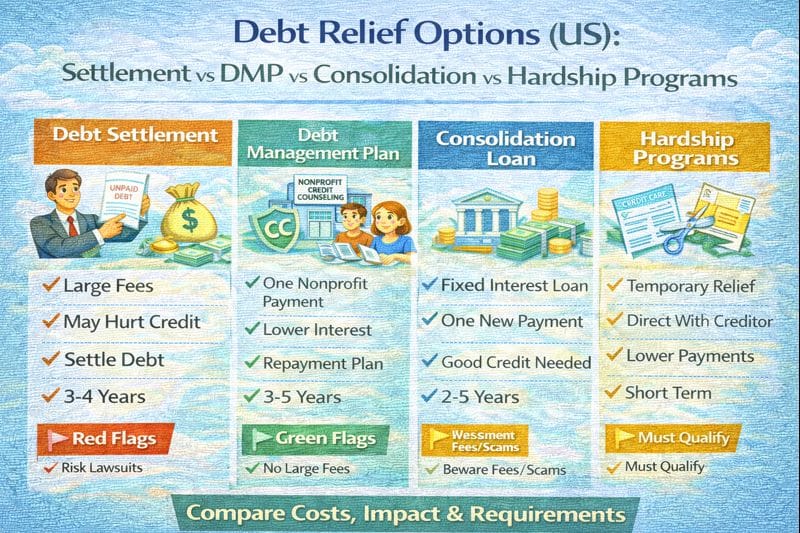
Debt relief isn’t a single program. It’s a set of options that help you lower payments, lower interest, or resolve balances—each with different costs, timelines, and risks.
This guide maps the main debt relief options for unsecured debt and helps you pick the right path based on one thing that matters: what you can realistically pay each month (and how much risk you can tolerate).
Quick answer / Key takeaways
- If you can repay 100% of principal with lower interest and structure, DMP is often the safest “program” option.
- If your hardship is temporary, start with hardship programs directly with your creditor (fast, lower risk).
- If you qualify for a meaningfully lower APR and won’t re-spend, consolidation can be the cleanest fix.
- If you cannot repay in full even with lower interest, settlement may be considered—but expect higher credit and legal risk.
- Best time to act: before delinquency. Once you fall behind, the timeline gets expensive fast.
- Scam rule: if someone pressures you or won’t put fees/timeline in writing, walk: debt relief scams red flags.
Start here: pick the right path (simple decision)
Choose based on your monthly capacity after essentials.
If you can pay monthly (and want structure)
Start with:
If you’re current (or close) and your issue is short-term
Start with:
- Hardship programs (with creditors)
If your credit/income is strong enough for a lower APR
Start with:
If you can’t keep up (and need reduction/resolution)
Start with:
Debt relief options list (quick overview)
Main options for unsecured debt:
- Debt settlement (negotiate to resolve for less than owed)
- Debt management plan (DMP) (structured repayment, often lower interest)
- Hardship programs (temporary relief directly with creditors)
- Debt consolidation (loan or balance transfer if you qualify)
What is the best debt relief option?
The best option is the one you can finish.
- If you can pay monthly → hardship or DMP usually comes first.
- If you can’t keep up → settlement may be considered (with risks).
- If you qualify for lower APR and stop re-spending → consolidation can work.
Quick comparison table: debt relief options
| Option | Best for | Typical timeline | Biggest risks |
|---|---|---|---|
| Debt settlement | You can’t repay full balances and need negotiated resolution | Often 24+ months (varies) | Credit impact, collections calls, lawsuit risk, possible taxes |
| Debt management plan (DMP) | You can pay monthly and want lower interest + structure | Often 3–5 years | Not forgiveness; accounts may be closed/restricted; agency quality matters |
| Debt consolidation (loan / balance transfer) | You qualify for meaningfully lower APR and won’t re-spend | Depends on term / promo period | Can end up deeper if spending continues; fees/terms matter |
| Hardship programs (with creditors) | Temporary hardship; want to avoid escalation | Often months | Not always available; terms vary by creditor |
What to do first (today)
- List each debt: creditor, balance, APR, minimum payment, status (current/late/collections).
- Calculate your real monthly capacity (budget with a buffer).
- Pick the path that matches capacity:
- can pay monthly → hardship/DMP
- can’t keep up → settlement (only after you understand consequences)
- qualify for lower APR → consolidation
- Stop new debt (pause cards, remove saved cards, spending rules).
- Get everything in writing (fees, timeline, and what happens if you miss a payment).
Deeper comparison: debt relief vs debt consolidation.
Option 1: Debt settlement
Debt settlement aims to resolve debts for less than owed through negotiation with creditors/collectors. In many cases it’s pursued after delinquency, which raises credit damage and collection pressure.
Read next
Option 2: Debt management plan (DMP)
A DMP is a structured repayment plan arranged via credit counseling, often with reduced interest rates and one monthly payment. It’s usually best when you can repay principal but the APR is suffocating you.
Read next
Option 3: Debt consolidation (loan or balance transfer)
Consolidation works when you can get a lower APR and your budget can handle the payment with buffer. The biggest fail mode is consolidating and then running cards back up.
Read next
- Debt relief vs consolidation
- (Personal loans route) Debt consolidation loans
- (Card route) Balance transfer vs personal loan
Option 4: Hardship programs (directly with creditors)
A hardship plan may temporarily lower your APR or payment and help you avoid escalation. It’s often the fastest low-risk move when the setback is temporary.
Read next
“Debt relief programs” explained (what people usually mean)
When people search “debt relief programs,” they usually mean:
- a DMP run through credit counseling (repayment structure),
- a settlement program (negotiation + funding plan + written agreements),
- or a creditor hardship plan (temporary reduced terms).
Key difference: repayment structure (hardship/DMP) vs negotiated resolution (settlement).
Debt relief alternatives (when you don’t want a program)
Before joining any program, consider:
- DIY hardship requests with creditors (rate reduction / payment plan)
- 0% balance transfer (only if you qualify and can pay it off fast)
- consolidation loan (only if APR drops and spending stops)
- strict payoff plan (avalanche/snowball) + budget reset
How to avoid scams (debt relief red flags)
If someone promises an outcome, pressures you to sign fast, or can’t explain fees/timeline in writing—bounce.
Read next
FAQ
What is the best debt relief option?
The best option is the one you can complete consistently. If you can pay monthly, a DMP may fit. If you can’t keep up, settlement may be considered. If you qualify for lower APR, consolidation can work.
Is debt settlement the same as debt relief?
No. Debt settlement is one type of debt relief. Debt relief can also include DMPs, hardship programs, and consolidation.
Can debt relief stop collection calls?
It depends. Calls may continue until an account is resolved. Always get agreements in writing and track communication.
Can creditors sue you for credit card debt?
Yes. Lawsuit risk depends on creditor strategy, balance size, and timeline. If you’re at risk, read: credit card lawsuit garnishment.
Should I stop paying credit cards to do settlement?
Don’t do it blindly. It can trigger collections and lawsuits. Read the timeline first: stop paying credit cards what happens.
Can I do debt relief without a company?
Often yes—budgeting and some negotiations can be done directly. For structured payoff, DMP/hardship can be done through legit channels without “settlement sales.”
Does debt relief reduce what I owe?
Settlement might. DMP and consolidation usually restructure repayment rather than reduce principal. Bankruptcy may discharge eligible debts.
What if I’m not sure which option fits?
Start with two numbers: your debt list and your monthly capacity. Those usually make the right path obvious.