
Where to go next
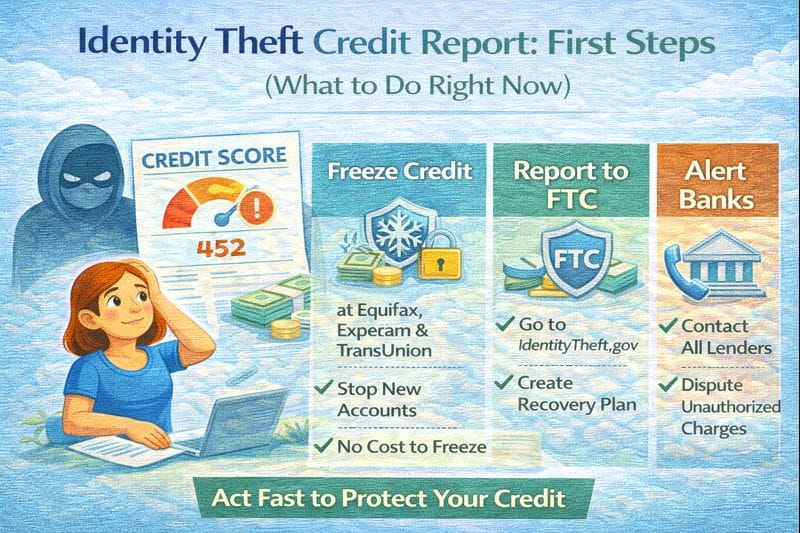
If you see accounts, addresses, or hard inquiries you don’t recognize, treat it as a time-sensitive cleanup, not a normal “credit dispute.” Your goals are:
- stop new fraud from happening,
- document what’s wrong,
- remove fraudulent accounts from your reports,
- rebuild control.
This guide gives you a clean first-steps plan, what to gather, and how the identity theft dispute process works.
Quick answer / Key takeaways
- First move: freeze your credit to stop new accounts: credit freeze vs fraud alert.
- Pull all three reports and list every fraudulent item: how to check credit reports.
- Dispute fraud with documentation and keep a paper trail.
- Don’t pay fraudulent debts “to make it go away.”
- Track results and re-dispute only with stronger documentation: credit dispute timeline.
What counts as identity theft on a credit report?
Red flags include:
- new accounts you didn’t open,
- hard inquiries you didn’t authorize,
- addresses/employers you don’t recognize,
- collections tied to unknown accounts,
- “authorized user” additions you didn’t approve.
If it’s only one weird inquiry, still treat it seriously until verified.
Hard inquiries.
What to do first identity theft (the exact order)
Step 1: Freeze your credit (prevention first)
Do this before you start calling anyone. Freezing shuts down a lot of new-account fraud instantly.
Credit freeze vs fraud alert.
Step 2: Pull and save your credit reports
Get all three reports and save copies (PDFs/screenshots).
How to check credit reports.
Create a list:
- bureau,
- fraudulent account/inquiry,
- date opened/inquiry date,
- balance/status,
- any linked addresses.
Step 3: Collect your proof packet
You’re building a “this is not mine” file. Common documents:
- government ID (copy),
- proof of address (utility bill/bank statement),
- a written statement listing fraudulent items (one page),
- any communications you receive about the fraud.
Step 4: Dispute the fraudulent items (bureaus + furnishers)
Identity theft disputes are stronger when you hit the right places:
- the credit bureaus showing the fraud, and
- the creditor/collector reporting the account.
General dispute mechanics: how to dispute credit report errors.
Step 5: Monitor for new fraud attempts
Fraud can be a wave. Keep your freeze on and check reports periodically until stable.
Remove fraudulent accounts from credit report (how it works)
This answers your tail: “remove fraudulent accounts.”
You’re asking for deletion/correction because the items are not attributable to you.
What you should submit (per bureau)
- a clear list of each fraudulent account/inquiry,
- copies of your ID and proof of address (as required),
- any supporting documentation that helps confirm timeline and identity.
What you should ask for (specific request)
For each item:
- “Delete this account/inquiry because it is the result of identity theft and was not authorized by me.”
Identity theft dispute process (what to expect)
This is your tail: “identity theft dispute process.” Here’s the reality map.
Stage 1: Confirmation + investigation window
Once submitted, you’ll get confirmations. Save them.
Stage 2: Bureau response
Outcomes look like:
- deleted,
- corrected,
- verified/no change.
If you get “verified,” don’t assume it’s over. It often means your packet wasn’t strong enough or the claim wasn’t coded correctly.
Credit dispute timeline.
Stage 3: Re-dispute or escalate with stronger documentation
If something remains:
- dispute again with a tighter claim,
- attach more proof,
- keep everything organized.
Table: Identity theft cleanup (what to do and why)
| Step | What you do | Why it matters |
|---|---|---|
| Freeze credit | Lock reports at all bureaus | Stops new account fraud |
| Pull reports | Save all three reports | Creates evidence baseline |
| Build fraud list | Account/inquiry/date per bureau | Prevents missed items |
| Submit disputes | Bureau + creditor/collector | Removes fraud at source |
| Track results | Confirm deletion/correction | Prevents “it came back” |
| Keep monitoring | Watch for new attempts | Fraud often repeats |
What not to do (common mistakes)
- Paying a fraudulent account to “clean it up.”
- Calling random numbers from suspicious letters without verifying.
- Filing vague disputes (“not mine” with no list or documents).
- Leaving your credit unfrozen while you investigate.
- Ignoring new inquiries because “it’s probably nothing.”
Examples / scenarios
Scenario 1: You see a new credit card you never opened
Freeze your credit, pull reports, dispute the account with a clear packet, and monitor for new inquiries.
Scenario 2: You see multiple inquiries across bureaus
Treat it as active targeting. Freeze now and list every inquiry by bureau/date.
Scenario 3: A collection appears for a bill you don’t recognize
Don’t pay it. Pull reports, treat it as identity theft, and dispute the underlying account and the collection.
Collections on credit report.
FAQ
What should I do first if I suspect identity theft?
Freeze your credit, pull all three reports, list every fraudulent item, and start the dispute process with documentation.
Credit freeze vs fraud alert.
How to check credit reports.
How do I remove fraudulent accounts from my credit report?
Dispute them with the bureaus where they appear and with the creditor/collector reporting them, using a clear list and supporting documents.
How long does the identity theft dispute process take?
It varies, but expect a multi-week cycle. Track statuses and follow up if results come back “verified.”
Credit dispute timeline.
Should I place a fraud alert or a credit freeze?
A freeze is usually stronger for preventing new accounts. Fraud alerts add verification friction but may not fully block approvals.
Credit freeze vs fraud alert.
Can I just dispute identity theft items online?
Sometimes, but for identity theft, having strong documentation and a paper trail is often worth it.
How to dispute credit report errors.