
Where to go next
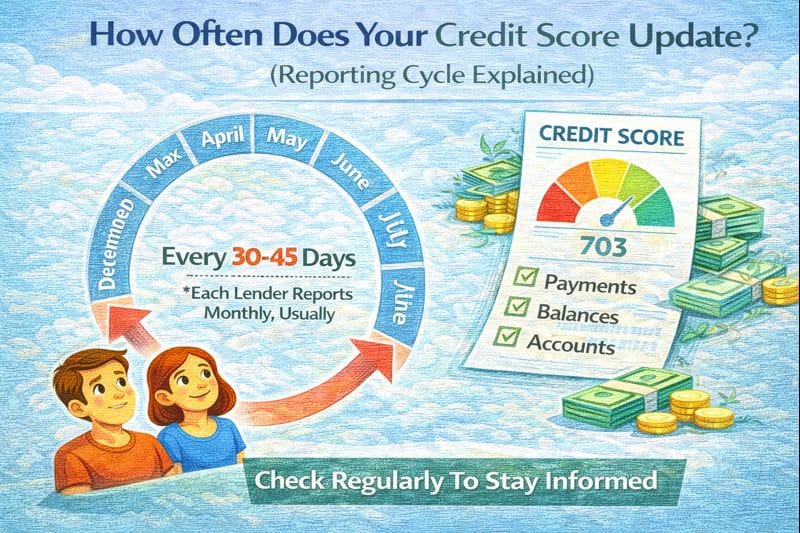
People assume credit scores update “daily” like a bank app. In reality, your score updates when new information hits your credit reports—usually tied to creditor reporting cycles. That’s why you can pay a card today and still see your score look unchanged for a bit, then jump later.
This guide explains how often credit scores update, when credit cards report to bureaus, how fast a score can change after payment, and how to time your actions (especially utilization) so you get the result you want.
Quick answer / Key takeaways
- Credit scores update when your credit report data updates—most often after creditors report on a cycle.
- Many credit cards report around the statement closing date, not the due date.
- Your score can change after a payment once the new balance is reported (timing varies).
- Utilization is the fastest-moving lever because it updates with reported balances: credit utilization.
- If you’re watching changes, check both your score and your reports: how to check credit reports.
How often does a credit score update?
A credit score updates whenever the underlying report data changes. Common triggers:
- a credit card reports a new statement balance,
- a loan reports a payment/status update,
- a new account opens,
- a hard inquiry posts,
- a late payment is reported,
- a collection is added or updated.
Hard inquiry rules: hard inquiries.
Dispute timeline if you’re correcting errors: credit dispute timeline.
When does a credit card report to bureaus?
This answers your tail: “when does credit card report to bureaus.”
The common pattern
Many issuers report once per month, often tied to your statement closing date. That means:
- if your statement closes with a high balance, that balance may be reported,
- even if you pay it off after the statement closes.
That’s why utilization feels “unfair” if you pay on time but at the wrong time.
Credit utilization.
Statement date vs due date (don’t mix these up)
- Statement closing date: creates the statement balance; often what gets reported
- Payment due date: deadline to avoid late fees/late reporting
If you want the fastest score improvements, optimize the statement balance—not just the due date.
Score change after payment (how fast can it happen?)
This answers your tail: “score change after payment.”
What must happen for the score to reflect your payment
- you make the payment,
- the balance decreases,
- the creditor reports the new balance,
- the bureau updates the report,
- the scoring model recalculates.
So yes—paying can help quickly, but only after the new balance is actually reported.
Why you sometimes see no change right away
- the issuer hasn’t reported yet,
- the score you’re viewing updates on a different schedule than the bureau update,
- another factor moved at the same time (new inquiry, new account, etc.).
Table: Common credit updates and when you’ll see them
| Event | What changes | When it usually shows up |
|---|---|---|
| Card payment | Balance decreases | After the issuer reports the new balance |
| Statement closes | Statement balance is set | Often the main reporting anchor |
| New hard inquiry | Inquiry appears | Often quickly after application |
| New account opened | New tradeline | After account setup + first reporting |
| Late payment | Delinquency mark | After the creditor reports it |
| Dispute update | Item corrected/deleted | After dispute resolves and bureaus update |
The utilization timing play (the “fast win” method)
If you want a near-term score lift, you usually want your statement balance to report low.
The simple method
- Find your statement closing date (from your account or statement).
- Pay your balance down before that date.
- Let the statement close with a low balance.
- Pay the remaining statement balance by the due date.
Full utilization tactics: credit utilization.
How to track your reporting cycle (without guessing)
Step 1: Pull your reports and look for “reported on” dates
Your credit reports show when an account last updated.
How to check credit reports.
Step 2: Match that date to your statement close
If they line up, you’ve found your reporting rhythm.
Step 3: Repeat for each card
Different cards can report on different days, which is why your score can shift more than once per month.
Common mistakes (that cause “I paid but my score didn’t move”)
- Paying after statement close (utilization still reported high).
- Assuming due date = reporting date.
- Watching one score source and thinking it’s the only truth (different scoring models update differently).
- Stacking new applications while trying to improve (new inquiries/new accounts offset gains).
Hard inquiries.
Examples / scenarios
Scenario 1: “My score dropped even though I paid on time.”
You likely had a higher statement balance report. Pay before statement close next cycle.
Credit utilization.
Scenario 2: “I need a score bump in a few weeks.”
Utilization timing is your best lever: lower balances before statement close and avoid new inquiries.
Scenario 3: “My report shows wrong balances or late marks.”
Dispute only real errors with proof.
How to dispute credit report errors.
Credit dispute timeline.
FAQ
How often does a credit score update?
Whenever the credit report data updates—often tied to monthly creditor reporting, plus any new inquiries/accounts or status changes.
When do credit cards report to credit bureaus?
Many report monthly, often around the statement closing date (varies by issuer and account).
How fast does a score change after payment?
After the new balance is reported and the bureau updates the report. Payments can help quickly, but timing controls when you see it.
Why didn’t my score increase after I paid my card?
If your statement already closed with a high balance, that high balance may have been reported. Lower utilization before statement close next cycle.
Credit utilization.
Do scores update daily?
Scores can be recalculated whenever new report data hits, but most credit accounts update on monthly cycles.